
Behind every business website is a stream of activity that visitors rarely see. Customers open pages, search engines request information, and AI systems retrieve content for several different purposes. This month’s Corpus Christi Digital Activity Report examines more than two million recorded server requests across an anonymized sample of 43 archived domains. The October 1–30 results show Google’s continuing importance as a source of identifiable search referrals, substantial declared AI activity, and a clear distinction between automated retrieval and measurable website click-through activity.
Our September report introduced the series and established an initial baseline. This edition continues that research with a longer reporting window and a changed website sample. Those differences matter: larger totals alone do not establish growth, and smaller totals do not establish a decline. This report focuses on what October’s available records show and what business owners can reasonably learn from them.

More Than Two Million Requests Behind the Scenes
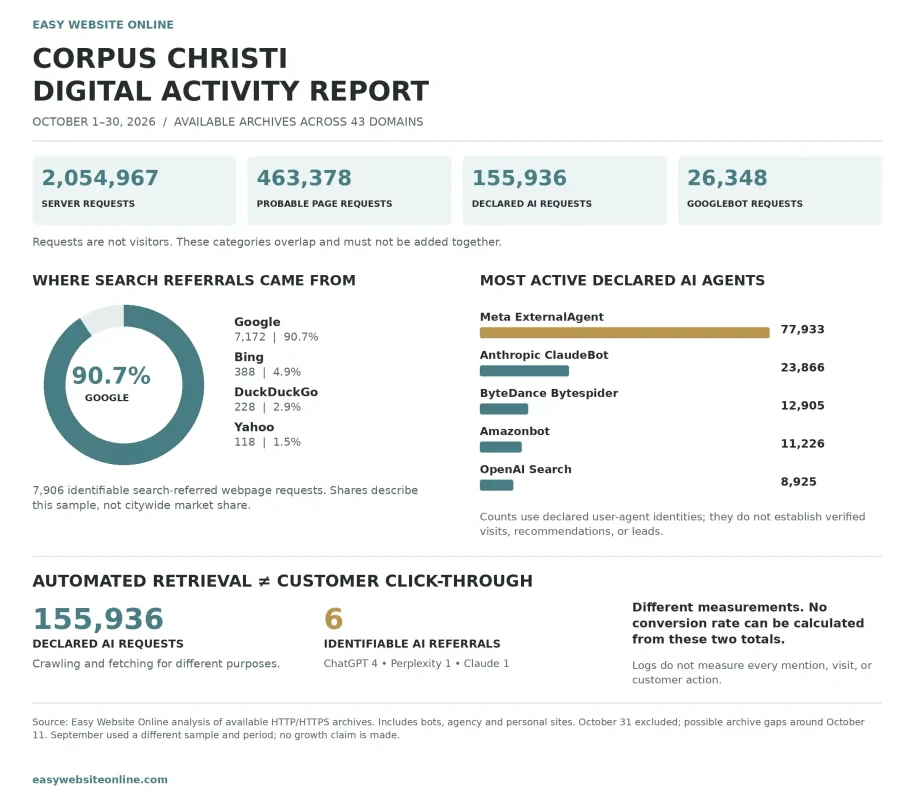
The available October archives contained 2,054,967 server requests across the sample. After filtering for successful GET requests and excluding many common static files and administrative paths, the analysis identified 463,378 probable webpage requests. That filtered figure still includes automated activity and should not be read as a count of customers. A single person, browser, or automated system can generate many requests.
| Measurement | Recorded total |
|---|---|
| Archived domains in the sample | 43 |
| Reporting period | October 1–30, 2026 |
| Total server requests | 2,054,967 |
| Probable webpage requests, including bots | 463,378 |
| Declared AI crawler and fetcher requests | 155,936 |
| Googlebot requests, reported separately | 26,348 |
These measurements describe different parts of the same activity and should not be added together. AI and Googlebot requests are included in the overall server total, and some also qualify as probable webpage requests. Images, scripts, stylesheets, unsuccessful requests, and other technical activity help explain why the overall count is much larger than the filtered webpage count. For business owners, the practical lesson is to ask what a reported number measures before treating it as evidence of customer interest.
Google Supplied About Nine Out of Ten Identified Search Referrals
The analysis recorded 7,906 successful probable webpage requests with recognizable referral information from Google, Bing, DuckDuckGo, or Yahoo. Google accounted for 7,172 of those requests, or approximately 90.7%. Bing supplied 388, followed by DuckDuckGo with 228 and Yahoo with 118. Within this sample and this classification, Google remained the leading identifiable traditional search referral source.
| Search source | Referred webpage requests | Share of these search referrals |
|---|---|---|
| 7,172 | 90.7% | |
| Bing | 388 | 4.9% |
| DuckDuckGo | 228 | 2.9% |
| Yahoo | 118 | 1.5% |
| Total | 7,906 | 100.0% |
These percentages are not search-engine market share for the entire city. They describe the recognized referrals present in the available logs, using the domains and filters included in this analysis. Referral information can be missing, and the classification does not capture every regional search domain or every way someone can discover a business. Even with those limitations, Google’s contribution is a strong reason to keep accurate business information, useful service pages, and a working customer contact path high on the priority list.
Which AI Agents Requested Website Content?
Declared AI crawlers and fetchers accounted for 155,936 requests during October 1–30. Meta ExternalAgent recorded the largest total at 77,933, followed by Anthropic ClaudeBot at 23,866 and ByteDance Bytespider at 12,905. Amazonbot and the search-focused OpenAI agent also appeared prominently in the records. The table below shows the complete breakdown identified by this analysis.
| Declared AI agent | Recorded requests |
|---|---|
| Meta ExternalAgent | 77,933 |
| Anthropic ClaudeBot | 23,866 |
| ByteDance Bytespider | 12,905 |
| Amazonbot | 11,226 |
| OpenAI Search / OAI-SearchBot | 8,925 |
| OpenAI GPTBot | 8,437 |
| PerplexityBot | 3,444 |
| ChatGPT User | 2,136 |
| Claude User | 1,625 |
| You.com | 1,597 |
| Perplexity User | 1,050 |
| Cohere | 1,033 |
| Claude Search | 1,009 |
| Meta ExternalFetcher | 750 |
| Total | 155,936 |
Not all of these agents perform the same job. OpenAI distinguishes OAI-SearchBot, which supports search, from GPTBot, which requests content that may be used for model training, and ChatGPT-User, which can retrieve pages for user actions. Perplexity similarly distinguishes its search crawler from user-triggered retrieval. This is why the combined total is described as declared AI crawler and fetcher activity rather than visits from potential customers. OpenAI’s crawler documentation and Perplexity’s crawler documentation explain these distinctions.
Crawling, Visibility, and Customer Visits Are Different Measurements
Alongside the automated activity, the analysis found six successful probable webpage requests with recognized AI-platform referral information. Four were attributed to ChatGPT, one to Perplexity, and one to Claude. No qualifying Gemini or Copilot referrals were identified by this particular classification. These are recorded requests, not verified people, unique visitors, sessions, or leads.
| AI referral source | Identifiable referred webpage requests |
|---|---|
| ChatGPT | 4 |
| Perplexity | 1 |
| Claude | 1 |
| Gemini | 0 identified |
| Copilot | 0 identified |
| Total | 6 |
The difference between 155,936 declared AI requests and six identifiable referred webpage requests deserves careful interpretation. It does not mean those requests formed a sales funnel, and the two figures cannot be used to calculate a conversion rate. Crawlers and fetchers have different purposes, while a referral indicates a separate request carrying recognizable source information. The logs also do not reveal whether a business was mentioned in an AI answer, whether someone called after reading it, or whether a visit arrived without referral information.
For businesses, this creates two separate questions. Can search and AI systems access accurate, useful information about the company? And does the company’s online presence help people take the next step when they are ready? Crawl activity can help us understand technical access, but it does not establish recommendations, customer trust, or sales results.
Where Google’s AI Features Fit
Googlebot made 26,348 requests in the available records, reported separately from the declared AI-agent table. These requests cannot reliably be assigned to conventional Google results, AI Overviews, or AI Mode from server logs alone. Likewise, a Google referral in this study does not tell us which search feature produced the visit. The Google referral total should therefore not be described as exclusively conventional blue-link traffic.
According to Google’s documentation for AI features, AI Overviews and AI Mode are included in overall Search Console performance under the Web search type. Google also says that established SEO practices remain relevant and that no special AI schema or additional machine-readable file is required for inclusion in these features. Clear textual information, accessible pages, useful internal links, and accurate business details remain practical foundations. This edition does not include Search Console impressions or Google Analytics engagement and conversion data.

Turn Better Information Into Better Customer Opportunities
October’s records give us a view of technical activity, but business decisions also need customer context. A company can receive repeated crawler requests while still leaving important customer questions unanswered. Someone comparing service providers needs to understand what the business does, where it works, why it is qualified, and how to contact it. Those are useful areas to review before investing in more traffic.
| Business priority | Practical review |
|---|---|
| Explain the services | Check that important services have clear, accurate descriptions and relevant pages. |
| Show real experience | Add original project photos, specific examples, and answers drawn from actual customer questions. |
| Clarify service areas | Confirm that visitors can tell whether their community is served. |
| Make contact straightforward | Test forms, phone links, appointment links, and the mobile contact experience. |
| Organize follow-up | Confirm who receives inquiries and how unanswered messages are handled. |
| Measure business outcomes | Use configured analytics and inquiry records to evaluate calls, forms, appointments, and qualified leads. |
These checks connect website development with the day-to-day work of winning and serving customers. Better content gives visitors more information to make a decision, while functioning forms and organized follow-up help the business respond. Analytics can then provide a separate view of engagement and measured actions. Together, these tools can help explain what happens beyond a raw request count.
Continue Building a Presence Customers Can Use
The October sample recorded substantial website activity, with Google providing most recognized search referrals and AI agents making more than 155,000 declared requests. Identifiable AI referrals were much smaller, and the available logs do not establish how often businesses were recommended or how many inquiries resulted. The useful next step is to connect technical access and discovery with clearer information, a better visitor experience, and measurable customer actions. That keeps the focus on what an online presence can help a business accomplish.
Easy Website Online helps Corpus Christi and Coastal Bend businesses develop websites, strengthen search and AI visibility, and organize customer follow-up. If you want to understand what your website communicates and where opportunities may be slipping away, schedule a free website presence analysis. We can review the current experience and identify practical improvements around your business goals.

Data and Methodology
This report uses available compressed HTTP and HTTPS access-log archives across two servers, filtered to October 1–30, 2026, using the dates recorded in those logs. The archive inventory contained 43 distinct domains; domains are not necessarily separate businesses, and the sample includes agency and personal sites. This is a convenience sample connected with Easy Website Online, not a representative survey of all Corpus Christi businesses or internet users. Individual domain results remain private.
Probable webpage requests were estimated using successful GET responses after excluding a defined list of common static-file extensions and administrative paths. The filter is approximate and does not remove every non-page resource or bot. AI identities were classified from declared user-agent strings and were not independently verified against published IP ranges. Recognized referrals were classified from selected source domains and do not measure all search or AI discovery.
Activity was present on every analyzed day across each server, but one server recorded unusually low activity late October 10 through early October 12. The cause has not been confirmed, and activity for some sites or hours may be incomplete. October 31 is excluded. September used approximately three weeks of records and a different 46-website sample; sample changes, reporting duration, possible archive gaps, and classification differences prevent a reliable month-over-month growth claim from these totals.
Sources
- Easy Website Online’s original October 1–30, 2026 archive analysis.
- Corpus Christi Digital Activity Report September 2026.
- OpenAI crawler documentation.
- Perplexity crawler documentation.
- Google Search Central — AI features and your website.