
Easy Website Online is launching the Corpus Christi Digital Activity Report, a recurring series examining how people, search engines, AI platforms and automated systems interact with local business websites. This inaugural edition establishes a three-week September 2026 baseline using an anonymized sample of 46 websites serving Corpus Christi and the surrounding region. Future editions will cover the complete previous calendar month, combine technical website activity with Google Analytics and Google Search Console data, and highlight meaningful changes in the local search environment.
Corpus Christi Is Firmly Connected
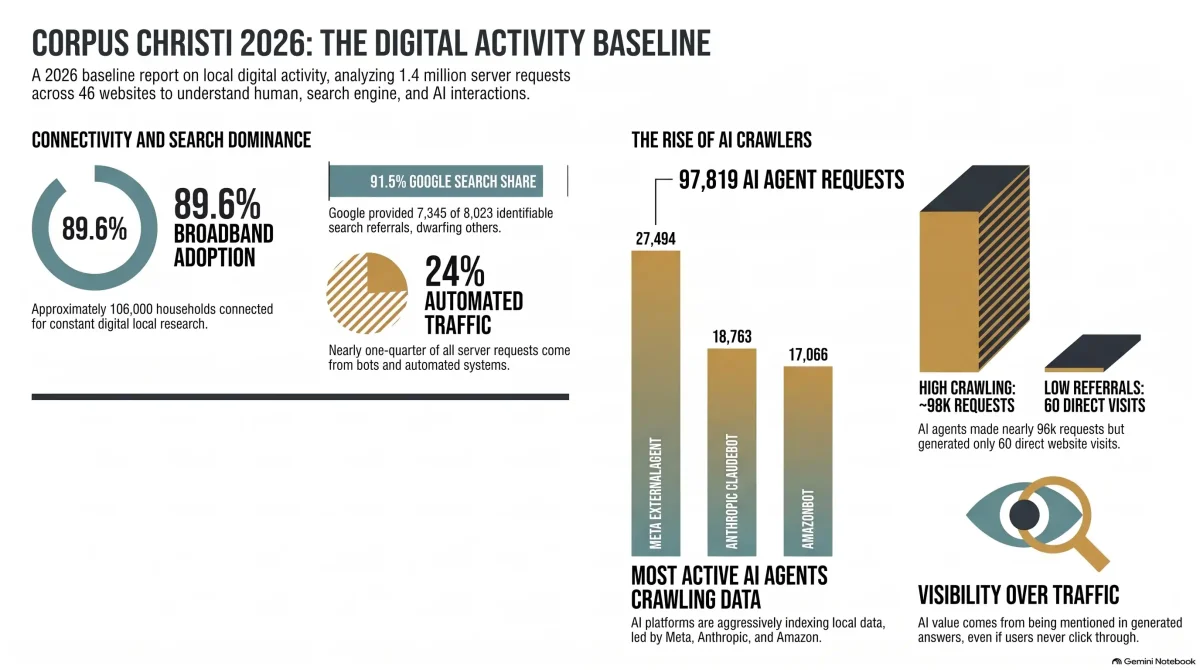
According to the U.S. Census Bureau QuickFacts profile for Corpus Christi, 89.6% of Corpus Christi households have a broadband internet subscription and 95.3% have a computer. With 118,741 households in the city, that represents approximately 106,000 households with broadband access. Local customers can research services, compare businesses, read reviews and decide whom to contact without ever walking through a front door. Customers, however, are only part of the activity taking place online. Search engines continually crawl websites to discover and update information, while AI platforms retrieve content to help answer questions. Monitoring services, security scanners and malicious bots also request information from business websites every day.
Three Weeks of Website Activity
During the study period, the anonymized website sample received more than 1.4 million server requests. Approximately 24% came from software that openly identified itself as automated, and the actual percentage was likely higher because some bots imitate ordinary web browsers.
The initial analysis identified:
- 1,422,598 total server requests
- 341,954 requests from clearly identifiable bots and automated systems
- 1,080,644 requests not identified as bots
- 310,761 probable webpage requests after removing common static files, administrative activity and unsuccessful requests
These figures do not represent 1.4 million individual visitors. Opening one webpage can create separate server requests for the page, images, scripts, fonts and other resources. The figures instead demonstrate how much technical activity occurs behind an ordinary-looking business website.
Google Still Dominates Identifiable Search Traffic
The study recorded 8,023 identifiable search-engine referrals. Google supplied 7,345 of them, accounting for more than 91% of the total. Bing, DuckDuckGo and Yahoo delivered substantially less identifiable referral traffic during the same period.
| Search engine | Identifiable referrals |
|---|---|
| 7,345 | |
| Bing | 384 |
| DuckDuckGo | 191 |
| Yahoo | 95 |
| Other | 8 |
| Total | 8,023 |
Referral information is not always passed to a website, so these numbers do not represent every visit originating from a search engine. Privacy settings, browser behavior and other technical factors can cause a search visit to appear as direct or unattributed traffic. Even with those limitations, the results reinforce Google’s continuing importance to businesses competing for attention in the Corpus Christi market.
AI Crawlers Are Already Highly Active
The AI-specific analysis covered September 1–21. During those three weeks, declared AI user agents made 97,819 requests across the anonymized website sample. These requests show that AI-related systems are already actively discovering, indexing and retrieving information from local business websites.
| AI system or agent | Crawler and fetcher requests |
|---|---|
| Meta ExternalAgent | 27,494 |
| Anthropic ClaudeBot | 18,763 |
| Amazonbot | 17,066 |
| OpenAI GPTBot | 9,532 |
| ByteDance Bytespider | 9,082 |
| OpenAI Search | 7,077 |
| ChatGPT User | 3,042 |
| PerplexityBot | 2,264 |
| Claude User | 1,413 |
| You.com | 910 |
| Perplexity User | 574 |
| Cohere | 306 |
| Claude Search | 294 |
| Other identified AI agents | 2 |
| Total | 97,819 |
Not all these requests serve the same purpose. Some automated agents collect or index publicly accessible information, while search-focused crawlers help their platforms discover pages that may later be presented as sources in AI-generated answers. User-directed agents may retrieve a webpage in response to a particular person’s question. For example, Perplexity explains that PerplexityBot supports its search results, while Perplexity-User may access a page when someone asks a question requiring information from that website. Similar distinctions exist between automated crawlers and user-directed retrieval systems operated by other AI companies. Because these figures are based on declared user-agent identities rather than verified individual visitors, they should be understood as declared AI-related activity recorded by the websites.
Visits From AI Engines Remain Small but Measurable
AI platforms did more than crawl the websites. They also referred people to them. The server logs recorded 60 identifiable AI-referred webpage requests during September 1–21.
| AI engine | Referred webpage requests |
|---|---|
| ChatGPT | 56 |
| Google Gemini | 3 |
| Perplexity | 1 |
| Total | 60 |
ChatGPT referrals reached at least 15 websites across the two portions of the sample. Gemini referrals appeared on three websites, while Perplexity generated one identifiable referral. These figures are best described as AI-referred webpage requests, not unique visitors or sessions, because one person can view multiple pages and referral information is not always passed to the destination website. The difference between 97,819 declared AI-related requests and 60 identifiable referrals is important. AI platforms are actively discovering and retrieving local business information, but direct click-through traffic is still emerging. A business may still receive value when an AI answer mentions, describes or recommends it, even when the user never visits the company’s website. This makes AI visibility different from traditional website traffic and more difficult to measure through server logs alone. Future reports will incorporate Google Analytics where available to provide a clearer view of AI-referred users, sessions, engagement and conversions.
What About Google AI Overviews?
The study separately recorded 24,639 Googlebot requests, but Googlebot activity cannot be divided reliably between conventional Google Search and Google’s generative-AI features. According to Google’s documentation for AI features in Search, AI Overviews and AI Mode use Google’s existing search and indexing systems. Pages must be indexed and eligible to appear in Search before they can be used as supporting links in these AI experiences.
Google Search Console now provides a dedicated Generative AI performance report. This report can show generative-AI impressions, the pages appearing in AI results, countries, devices and visibility over time. It covers features such as AI Overviews and AI Mode, but it does not provide separate click totals for each feature. Clicks from Google’s AI features remain part of the broader Google Search performance data. Future editions of the Corpus Christi Digital Activity Report can incorporate these impressions and compare changes in local business visibility over time. Googlebot requests are reported separately in this study and are not included in the 97,819 declared AI crawler and fetcher requests.

A Business Website Now Serves Several Audiences
A local business website must communicate effectively with several audiences at once. It must first serve customers by providing clear service information, useful photos, accurate contact details, evidence of experience and an obvious next step. Visitors should be able to determine quickly whether a company offers the service they need and works in their area. The website must also help search engines interpret the business. Crawlable pages, logical organization, local relevance, helpful content, structured data and dependable performance all influence how easily a company can be discovered. Google advises website owners to continue following foundational SEO practices for conventional Search and its AI features.
Increasingly, the website must provide clear and reliable information to AI systems as well. A company with vague, thin or inconsistent content gives ChatGPT, Gemini, Perplexity and other platforms very little dependable information to use when answering questions or recommending businesses. AI visibility depends partly on whether these systems can find, access and understand accurate information about the company.
Finally, the website must withstand unwanted automation. Security scanners and malicious bots probe login pages, search for outdated software and consume server resources. Maintenance, security controls and efficient code are therefore essential parts of a trustworthy online presence.
Local Customers Expect Useful Answers
A prospective customer may arrive with several specific questions. Does the company serve this part of Corpus Christi? Does it provide the exact service needed? Is the business experienced and legitimate? Can the visitor see examples of its work, and what happens after an estimate or consultation is requested?
If the website cannot answer those questions, the customer can return to Google, ask an AI assistant or choose another company within seconds. Locally specific content helps customers, search engines and AI platforms understand a business. That does not mean repeating “Corpus Christi” unnaturally throughout every paragraph; it means publishing complete and accurate information about real services, service areas, experience and customer needs.
Access and Performance Still Matter
Corpus Christi’s 89.6% broadband subscription rate is substantial, but it also means approximately 12,000 households do not have a broadband subscription. Some residents rely primarily on mobile connections, shared access or slower service. Oversized images, unnecessary scripts, bloated plugins and complicated designs can create real barriers for these users. A fast, mobile-friendly website makes a business easier to reach across a community using different devices and connection speeds. Accessibility, readable text, straightforward navigation and properly optimized images improve the experience for everyone. They can also make the website easier for search engines and automated systems to process.
Corpus Christi is also linguistically diverse. The U.S. Census Bureau reports that 32.1% of residents age five and older speak a language other than English at home. Not every company needs a fully bilingual website, but clear writing, intuitive navigation and thoughtfully selected Spanish-language information can make important services easier to understand.

Announcing a Continuing Monthly Report
This initial report establishes the baseline for the Corpus Christi Digital Activity Report series. Future editions will cover the previous complete calendar month and compare results over time. The goal is to create an ongoing view of how local customers find businesses and how the Corpus Christi search environment changes.
Planned measurements include:
- Users, sessions and engagement from Google Analytics
- Organic, direct, referral, social and paid traffic
- Traditional search-engine referrals
- AI crawler and user-directed fetch activity by platform
- Visits from ChatGPT, Gemini, Perplexity, Claude and Copilot
- Google AI Overview and AI Mode impressions
- Form submissions and other measured conversions
- Mobile, desktop and tablet use
- Seasonal changes in local customer interest
- Growth or decline by business category
- Meaningful changes in the Corpus Christi search environment
Server logs, Google Analytics and Google Search Console measure different aspects of online activity. Their figures should not be added together as though they represent the same thing. Used together, however, they can reveal how customers discover local companies, how they behave after arriving and how automated systems interpret the same websites. Google also recommends using Search Console and Google Analytics together to develop a more complete understanding of website discovery and visitor behavior. Adding these sources to future reports will allow us to move beyond raw activity totals and identify changes in engagement, visibility and conversions.
Build for People—and Be Understood by Technology
Corpus Christi’s digital market is active, competitive and increasingly influenced by AI. Google remains the leading identifiable source of conventional search referrals, while AI systems are already requesting local business content at substantial scale. Direct visits from AI engines are still comparatively small, but they are now measurable. A successful website must work for both people and technology. It should feel simple and useful to a customer while providing the structure, speed and clarity that search engines and AI platforms need to understand it. Businesses that publish accurate, useful and locally relevant information will be better positioned as online discovery continues to change.
Easy Website Online builds and improves websites for Corpus Christi businesses with this complete environment in mind. If your website is difficult to use, slow to load or unclear about what your company offers, it may be costing you opportunities before a customer ever contacts you.
Is your website ready for the way Corpus Christi searches in 2026? Contact Easy Website Online to review your website, identify weaknesses and plan practical improvements.

Data and Methodology
Household, computer, broadband and language figures come from the U.S. Census Bureau QuickFacts profile for Corpus Christi, Texas, using the latest 2020–2024 estimates available in 2026. Easy Website Online’s original study figures are based on an anonymized review of technical activity across a 46-website sample during approximately three weeks in September 2026. The AI-specific analysis covers September 1–21.
Server requests are not equivalent to individual visitors or sessions. The analysis excluded common static assets, administrative paths and unsuccessful requests when estimating probable webpage activity. Declared crawler identities were determined from user-agent strings and were not independently verified by IP address. Google Analytics and Google Search Console generative-AI data were not included in this inaugural report. Future editions are intended to combine these sources while keeping individual business information private.